Push and Pull, the Two Best Upper Body Exercises
Pushing and pulling are two fundamental human movements. I put them—along with squat, hinge, and carry—at the center of every workout program I design.
In daily life we push doors open, push ourselves up off the ground, and lift things overhead. We also pull doors open, pull ourselves up, and maybe even play tug-o-war or row a boat.
Using these movements in resistance training to build strength and muscle improves our life by making those daily activities easier.
Muscles Used When Pushing and Pulling
When we put our hands to our chest and push away from our body (horizontal push), we use our chest, upper arm, and shoulder muscles: pectoralis major, triceps, and deltoids. When we push overhead (vertical push), the focus changes to our shoulders but it still works the upper chest and upper arms, and adds upper back muscles: deltoids, pectoralis major, triceps, and trapezius. No matter the direction, we push against our core muscles, causing them to get stronger, too.
When we reach out and pull something toward us (horizontal pull), we use our back, shoulders, upper arms, and forearms: rhomboids, trapezius, latissimus dorsi, deltoids, biceps, and wrist flexors. When we reach up and pull something down or pull ourselves up (vertical pull), the focus shifts: latissimus dorsi, trapezius, deltoids, biceps, and wrist flexors. Our core muscles are engaged for stabilization.
Basic Preparation for Pushing and Pulling
Before pushing or pulling something heavy, make sure you have a secure foundation, either feet on the floor or butt on a chair. Then, take a deep breath, lengthen your spine and roll your shoulders back.
Horizontal Push Variations
The barbell bench press may be the textbook horizontal push exercise (Keep in mind that “horizontal” is relative to the body not to the ground), but it is far from the only one.
Push Up
The push up is the standard go-to for a no-equipment-needed pushing exercise. However, a full standard pushup is really hard to do for most people.
I coach people to find ways of placing the hands and shoulders higher than the feet to reduce the amount of weight that is being lifted. Then, over time, slowly lower them as you get stronger.
I recommend using a staircase because it has many options. Place your hands shoulder width or wider on your chosen step and adjust your shoulders and feet so that your body forms a straight line from head to heels. Lower your chest to the step and push back up.
For more challenge, choose a lower step. For less challenge, use a kitchen counter or a wall.
The Hybrid Calisthenics channel has the kindest, friendliest, most helpful video about pushups on the internet. Check it out: You CAN do pushups, my friend!
Standing Resistance Band Chest Press
Bands are great, especially when you are traveling, because they take almost no room and weigh almost nothing. They come in different styles and levels of stretchiness. Choose a band that works for you.
Anchor the band according to the manufacturer’s instructions at chest height, and stand with your back to the anchor. Step one foot forward and one foot back, keeping them hip width or slightly wider. Softly bend both knees. Keep your hips square and your shoulders above your hips.
With one handle in each hand, start with your hands at your armpits. Push directly forward until your arms are straight. Slowly return your hands to your armpits, resisting the pull of the band.
To make the exercise easier, stand closer to the anchor point. To progress the exercise, take a step forward or choose a heavier band.
Seated Self-Anchored Resistance Band Chest Press
The resistance band chest press can be done seated, and you can use yourself as the anchor.
Wrap the band around your mid-upper back and pass the ends out under your armpits. Place your feet flat on the floor and sit up straight.
Grab the band just in front of your body. Push directly forward until your arms are straight. Slowly return your hands to your armpits, resisting the pull of the band.
To make the exercise easier, grab the band farther from your body. To progress the exercise, grab closer to your body or choose a heavier band.
Dumbbell Floor Press
Choose two medium-weight dumbbells and lie on the floor on your back. Hold the dumbbells at the sides of your chest and position your legs any way that is comfortable for your back.
Push up until your arms are straight, but not locked. Slowly lower your elbows back to the ground.
Experiment with keeping your elbows alongside your body, placing them directly out from your shoulders, or choosing an angle in between.
Dumbbell Bench Press
If you have a bench, you can benefit from more range of motion.
Follow the instructions for the Dumbbell Floor Press, with one change: Lower your elbows below the surface of the bench, and push up from there.
Vertical Push Variations
Overhead press is the standard vertical push. It can be done with a traditional barbell, or with anything heavy.
Resistance Band Overhead Press
Stand in the middle of a long band. Hold one end in each hand in front of your shoulders. Together, or one at a time, push your hands as high as you can and then slowly lower them.
If your band is too short or stiff to perform this standing, you can sit in the middle of the band on a sturdy chair.
Lying Self-Anchored Resistance Band Overhead Press
Lie on your back and loop the center of a long band around the bottoms of your feet. Be sure the band is secure and won’t slide off.
Hold one end of the band in each hand at your shoulders. Together, or one at a time, push your hands “above” your head and then slowly return them to the starting point.
Pivot Press
Carefully suspend a kettlebell or dumbbell from the ceiling or secure point above you. Aim to have the weight at hip-height or slightly higher.
Place your hand on the weight and walk forward, keeping the suspension tight, until the weight is at shoulder height. Step your corresponding foot back and opposite foot forward keeping them hip width or slightly wider. Softly bend both knees and keep your hips square.
Push your arm up and forward, hinging at your hips. Aim to form a straight line from your heel, through your hip, through your shoulder, to your hand. Slowly lower the weight to the starting position.
[video coming soon]
Dumbbell Overhead Press
Stand tall and step your feet so they end up under your hip joints or slightly wider. Hold a dumbbell in each hand. It should be heavy enough to challenge your muscles, but light enough you feel confident lifting it overhead.
Begin by holding the dumbbells in front of your shoulders. Together, or one at a time, push the dumbbells as high as you can and then slowly lower them.
Aim to keep the dumbbell directly over your shoulder. It is acceptable if it is slightly forward. If it is significantly forward, try the pivot press or one of the other variations.
Horizontal Pull Variations
The textbook horizontal pull is the barbell or dumbbell row, but anytime you reach out and pull something toward you, you are doing it.
Seated Self-Anchored Resistance Band Row
Sit on a sturdy chair or on the floor. Stretch your legs out in front of you with your heels down and your toes pointed up and away.
Sit up straight and grab the band with straight arms. Pull your elbows behind you as far as you can. Slowly reach your hands forward to the starting point, resisting the pull of the band.
To make the exercise easier, grab the band a little farther from your feet. To progress the exercise, start with more resistance in the band by grabbing closer to your feet before sitting up, or choose a heavier band.
Standing Resistance Band Row
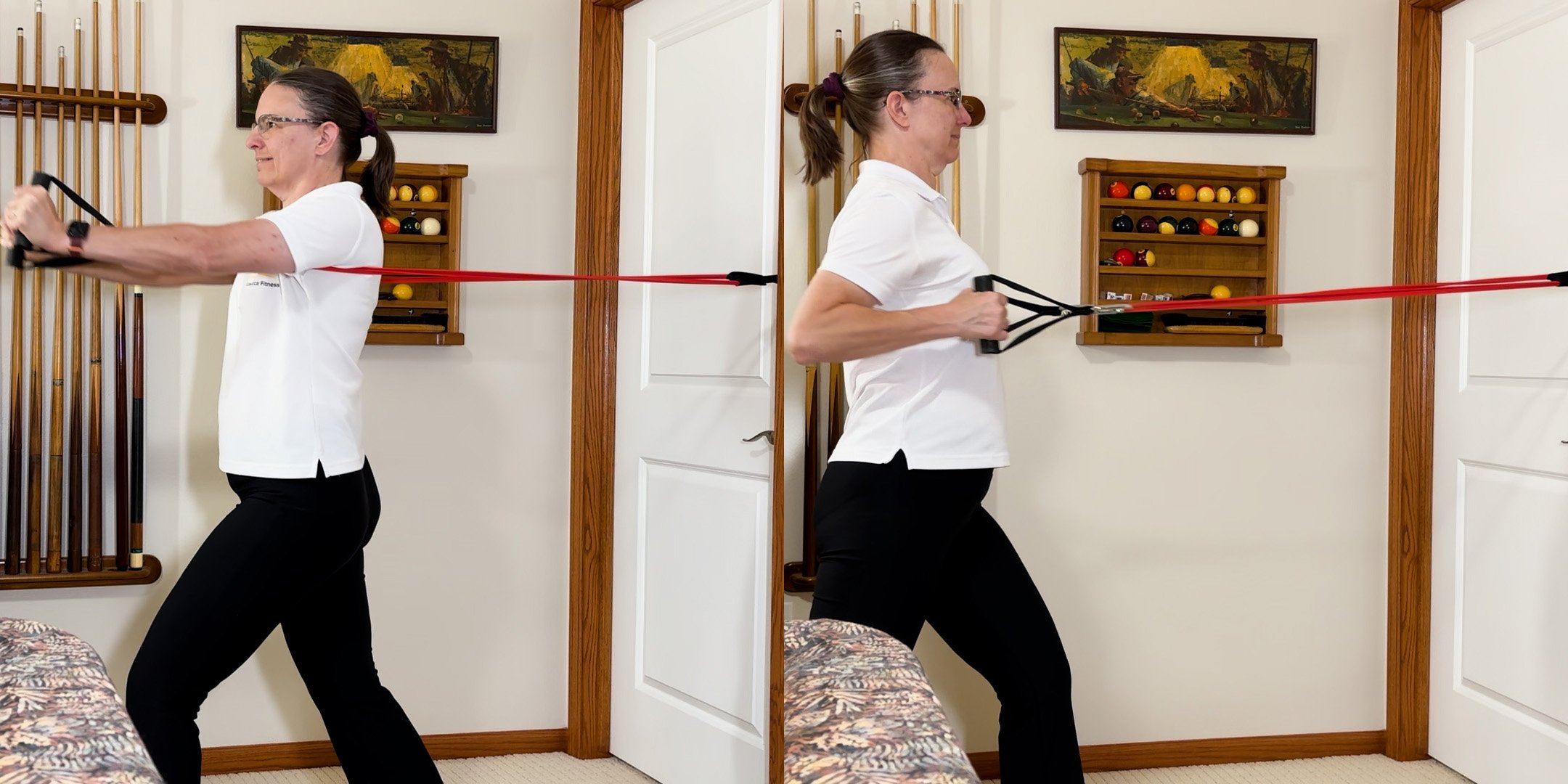
Anchor the band according to the manufacturer’s instructions at chest height, and stand facing the anchor. Step one foot forward and one foot back, keeping them hip width or slightly wider. Softly bend both knees. Keep your hips square and your shoulders above your hips.
With one handle in each hand, start with your hands outstretched. Pull your elbows behind you until your hands are at your chest. Slowly reach your hands forward to the starting point, resisting the pull of the band.
To make the exercise easier, stand closer to the anchor point. To progress the exercise, take a step backward or choose a heavier band.
Dumbbell One-Arm Row
With a medium to heavy dumbbell in one hand, step that foot back and the other foot forward, keeping them hip width or slightly wider. (Or stand with your feet side-by-side hip width or slightly wider.) Softly bend both knees. Square your hips and shoulders. Keeping your torso long and neutral, hinge forward at your hips. Your gaze should fall on the floor out in front of you.
Let your free hand land on a chair, a bench, or your forward thigh. Let your weight arm dangle, then pull your elbow up and your shoulder up. Slowly return your arm to the dangling position.
Suspension Row
A suspension system such as TRX is a good investment. Like resistance bands, it takes of little room and is easy to transport.
Anchor the system according to the manufacturer’s instructions above your head. Stand facing the anchor with one handle in each hand. Begin with your hands at the sides of your chest and the straps taunt. Make sure your feet will not slip, and straighten your arms to lower yourself down and back. Pause, and then pull yourself back up to the start.
To make the exercise easier, stand farther from the anchor point. To progress the exercise, move your feet closer.
[video coming soon]
Vertical Pull Variations
The common example of a vertical pull is a pull up, but it is not the only way to do it.
Pull Up
I don't regularly use pull ups with my clients, so I don't have instructions and a video for you. However, I would be remiss if I wrote an article about pushing and pulling and didn't mention it at all.
Hampton of Hybrid Calisthenics has a friendly, helpful video about pull ups that is almost as good as his push ups video. Check it out: You CAN do pullups, my friend!
Resistance Band Pulldown
Anchor the band according to the manufacturer’s instructions above your head. Sit on a low chair facing the anchor and hinge forward, reaching toward the anchor. Grab the band, one end in each hand.
Pull your elbows down along your sides and pull your shoulder blades together. Extend your hands back to the start, resisting the pull of the band.
To make the exercise easier, sit closer to the anchor point. To progress the exercise, scoot your chair backward or choose a heavier band.
Resistance Band Pullover
Anchor the band according to the manufacturer’s instructions above your head. Stand with your back to the anchor. Step one foot forward and one foot back, keeping them hip width or slightly wider. Softly bend both knees. Keep your hips square and your shoulders above your hips. Reach overhead and grab the band.
With your arms mostly straight—just a slight bend at the elbow—arc your hands forward and down. Finish just below your shoulders so that your hands, shoulders, and the anchor are in a nearly straight line. Then slowly arc your hands back up to the starting point, resisting the pull of the band.
To make the exercise easier, stand closer to the anchor point. To progress the exercise, take a step forward or choose a heavier band.
Plank with Band Pull
Anchor the band low to the ground, either with a door anchor or around a heavy piece of furniture. Position yourself in the plank of your choice—hands or elbows, knees or toes—facing the anchor.
Reach one hand toward the anchor and grab the band. Maintain good plank position, keeping your hips and shoulders square.
Pull your elbow back along your side. Extend your hand back to the start, resisting the pull of the band.
Summary
This article covers the push and pull variations I most commonly use with my clients. I hope you find this helpful. Check out the companion article, “Squats and Hip Hinges, the Two Best Lower Body Exercises.”
If you would like a custom program and personal guidance for building strength and muscle mass using push and pull exercises, squats and hip hinges, and more please contact me.

Note: If you are healthy and make only gradual increases to your activity level, you do not need to consult a health care professional before you begin. However, if you have one or more chronic conditions or plan to make a big change, see your doctor first. Always work within your ability. With any activity/exercise program, if you feel faint or dizzy or experience pain or loss of balance, you should stop immediately.